

We take another look at the travel journals and letters of Robert Tassell and his son’s journey through the Victorian ‘Holy Lands’ you can read more about the dangers and challenges faced. Robert Tassell Sr, the builder of Cobdown House, was an interesting character who faced considerable hardships and adventures when travelling the Middle East in 1839.
An English Expedition Into The Holy Lands
In an age when travel was perilous, few journeys rival the ordeal undertaken by Robert Tassell Senior, a solicitor of the Inner Temple, and his son Robert Tassell Junior. Their 1839–1840 expedition through Egypt, Sinai, Arabia Petra, Palestine, and Syria—recorded in the father’s letters to his daughter Mary and the son’s meticulous travel diary—reads not as a leisurely tour, but an adventure story.
Their accounts, preserved today in both journal and correspondence, reveal a world where beauty and peril stood side by side: ancient temples and treacherous deserts, Biblical landmarks and lurking disease, royal court intrigues and lawless frontiers.
Egypt: Splendour in the Shadow of Plague
The voyage from England, begun 30 October 1839, was marked early by storms that nearly forced their vessel back to port. After a battered passage through Malta, they reached Alexandria, only to find a city under the constant spectre of plague. Soldiers guarded quarantines, funerals passed endlessly, and travellers moved in fear of invisible contagion.
In Cairo, where the Tassells ascended the Nile, the father wrote of “a wilderness of suffering amid monuments of the sublime.” Slave markets, beggars, and oppressive heat shaped their days. The son, in his diary, describes a foetid atmosphere where European travellers resorted to vinegar-soaked cloths to purify the air.
Yet amid the danger, they pressed on to the pyramids, venturing into narrow, collapsing passages where a misstep meant asphyxiation.
A Treacherous Crossing: The Sinai Desert
No part of their odyssey proved more harrowing than the camel crossing of the Sinai. With them travelled Mr Formby, a fellow Englishman, along with a small army of servants—Egyptian camel drivers, a Maltese interpreter, and Arab guides whose loyalty was never entirely certain.
Cold nights and furnace-like days battered them; sandstorms blinded both man and beast. Their water bags tore open; their food spoiled. The elder Tassell wrote to Mary: “We are at the mercy of the desert, and the desert has no mercy to give.”
One night, Bedouin horsemen circled their camp. The guides claimed they were “friendly watchers,” but the travellers slept with pistols in hand.
At last they reached St Catherine’s Monastery, a fortress of faith surrounded by desolation. Here, monks welcomed them with sparse rations and prayers, though even within the thick walls they feared raiders from the mountains.
Petra: Beauty Hidden in Bandit Country
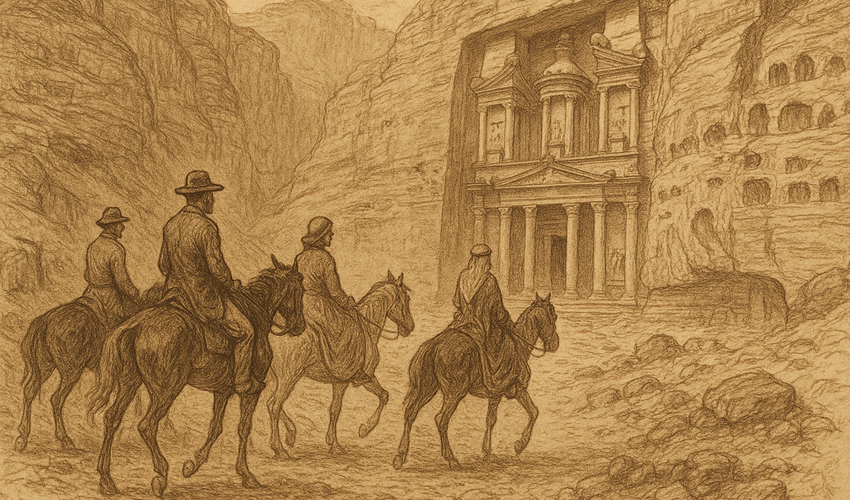
From Sinai, the caravan descended into Arabia Petraea, reaching the fabled rose-red city of Petra. The son’s journal illustrates narrow canyons where a single armed man could ambush a caravan without escape.
Their local escorts insisted on travelling fully armed. The younger Tassell wrote: “We rode between cliffs that rose like tombs, and in every shadow we imagined a rifle.”
Petra itself—magnificent, haunting, deserted—was overshadowed by the knowledge that travellers had been robbed or murdered in precisely those gorges only months before.
Jerusalem: Holy City, Hostile Circumstances
In the Holy Land, the travellers entered a city divided not only by faith, but by faction. At the Church of the Holy Sepulchre, rival Christian sects fought openly over processions. Ottoman guards had to keep peace at sword-point.
The Tassells lodged with Protestant missionaries Mr Nicolayson and Mr Grimshawe, who themselves lived behind bolted doors for fear of nighttime intruders. The elder Tassell noted: “Jerusalem is sacred ground, but its dangers are earthly.”
Their excursion to the Dead Sea was worse. Travelling with pilgrims under Ottoman escort, they were warned of marauding tribes. At camp in the Jordan Valley, a sentry fired into the darkness to scare away prowling thieves.
Storms, Plague, and Thieves in the North
Moving on to Samaria and Nazareth, the party found villages barricaded against plague. They were denied entry, forced to sleep outdoors in freezing wind. Their Arab guards—called seys—kept watch for bandits said to ambush lone travellers.
Near Acre, they met brigands openly carrying spoils taken from coastal travellers. Even the roads to Tyre and Sidon, though scenic, were lined with ruined houses burned during recent conflicts
Lebanon: The Emir’s Hospitality Amid Unrest
In Mount Lebanon, the Tassells finally found respite. Emir Beshir II Shihab, the mountain ruler, summoned them to his palace at Beiteddine. Yet even here, unrest simmered. Druse and Maronite factions skirmished in the hills; Ottoman troops mustered nearby.
The Emir himself warned his guests never to travel at dusk: “In these mountains, night belongs to the wolves—four-legged and two.”
Still, they enjoyed rare safety, dining in marble halls and touring terraced gardens.
Final Leg: A Daring Escape to Constantinople
Roads into the Syrian interior were cut off by plague. Unable to reach Damascus or Baalbek, the travellers raced to Beirut, securing passage on a ship crowded with refugees and sick passengers.
A storm nearly wrecked the boat off Cyprus. By the time they reached Constantinople in June 1840, both men were exhausted. But the sight of the city—its domes, its minarets, the sweep of the Bosphorus—revived their spirits.
The father wrote his final letter to Mary: “We have lived a lifetime in these months, and cheated death a dozen times.”
Through their letters and drawings there remains a record not only of landscapes and ruins, but of grit, faith, and spirits tested to its limits.
Their writings stand today as one of the most remarkable accounts of pre-modern Middle Eastern travel—a journey where every horizon held both danger and wonder.
Summarised from Letters and Journals held at Middle East Centre, St Antony’s College, University of Oxford.